|
Environmental Management System EMS 05-04 Bio Fouling Plan and Record Keeping |
Doc No.: EMS-05-04 Revision: 0 Date: 15Apr 2023 Issued by: DPA Approved by: MD |
1. BIO FOULING MANAGEMENT PLAN AND RECORD BOOK IMO REQUIREMENT
The introduction of invasive aquatic species to new environments by ships has been identified as a major threat to the world’s oceans and to the conservation of biodiversity. A multitude of marine species, carried either in ships’ ballast water or on ships’ hulls, may survive to establish a reproductive population in the host environment, becoming invasive, out-competing native species and multiplying into pest proportions. Therefore, on 15 July 2011 IMO adopted Resolution MEPC.207(62) 2011 Guidelines for the Control and Management of Ships' Biofouling to Minimize the Transfer of Invasive Aquatic Species.
As per this resolution All vessels must have onboard a Bio Fouling Management plan and Record book.
1.Biofouling Management Plan
All company managed vessels are provided with a Biofouling management plan on takeover. The intent of the plan is to provide effective procedures for biofouling management. The Biofouling Management Plan should be filled with ship-specific details once received onboard. The plan addresses, among other things, the following:
- Relevant parts of MEPC 207(62) Guidelines.
- Details of the anti-fouling systems and operational practices or treatments used, including those for niche areas.
- Hull locations susceptible to biofouling, schedule of planned inspections, repairs, maintenance, and renewal of anti-fouling systems.
- Details of the recommended operating conditions suitable for the chosen anti-fouling systems and operational practices.
- Details relevant for the safety of the crew, including details on the anti-fouling system(s) used.
- Details of the documentation required to verify any treatments recorded in the Biofouling Record Book as outlined in appendix 2.
- The biofouling management plan should be updated if & as with records being updated regularly.
Biofouling Record Book
Every vessel must maintain Biofouling records in the company supplied Biofouling Record Book and/or in the Plan itself in recording sections (Until the record book is received). The book should record details of all inspections and biofouling management measures undertaken on the ship. This is to assist the shipowner and operator to evaluate the efficacy of the specific anti-fouling systems and operational practices on the ship, and of the biofouling management plan in general. The Biofouling Record Book should be retained on the ship for the life of the ship.
Information that should be recorded in a Biofouling Record Book includes the following:
2. REGIONAL REQUIREMENTS
Regional Requirements
The regional requirements described in this section at the time of publishing include specific requirements by the United States of America, New Zealand, and Australia. Any future requirements by other Administrations in addition to the IMO Resolution MEPC.207(62) “2011 Guidelines for the Control and Management of Ship’s Biofouling to Minimize the Transfer of Invasive Aquatic Species”.
A. United States of America:
The Biofouling Record Book is to:
- Contain details of all in-water inspections and biofouling management measures undertaken since the most recent out-of-water maintenance or delivery (if the vessel has never undergone out-of-water maintenance).
- Be consistent with the Biofouling Record Book described in the IMO Biofouling Guidelines.
- Include descriptions of niche area management practices, as required by 2 CCR section 2298.6(c)(2).
B. California Biofouling Requirements:
California requires that any New Vessel upon delivery after January 1, 2018, must have a Biofouling Management Plan and for Existing Vessels, the same must be in place after the first regularly scheduled out-of-water maintenance on or after January 1, 2018. All vessels must have an AFC lifespan certificate. If a vessel is using an antifouling coating, the antifouling coating should not be aged beyond its effective coating lifespan. If the coating exceeds its lifespan, the Biofouling Management Plan shall document how biofouling will be managed after the expected coating lifespan is exceeded. If a vessel is not using an antifouling coating, the Biofouling Management Plan should describe how biofouling will be managed in the absence of an antifouling coating. All management actions should be documented in the Biofouling Record Book.
California State regulations require the submission of the Marine Invasive Species Program Annual Vessel Reporting Form to the CSLC. Submission is required at least 24 hours in advance of the first arrival of each calendar year at a California port. The MISP website and Reporting Portal: https://www.slc.ca.gov/misp/
C. New Zealand Biofouling Requirements:
Beginning May 15, 2018, all commercial and recreational vessels arriving in New Zealand will need to meet the "clean hull" requirement. Ref MPI Circ May-2018, a vessel which does not meet the “clean hull” threshold for its length of stay will face action such as to carry cleaning of Hull and, if such is not possible, the vessel may be asked to leave New Zealand. Since hull cleaning arrangements are limited in New Zealand for larger vessels, it is important to meet the standard through continual hull maintenance and good recordkeeping to avoid delays.
Clean Hull Requirement: A hull is a ‘clean hull’ when no biofouling of live organisms is present beyond the thresholds. One of the following measures must be applied to meet the ‘Clean Hull’ requirement:
- Cleaning before the visit to New Zealand (or immediately on arrival in a facility or by a system, approved by MPI). All biofoulings must be removed from all parts of the hull and this must be carried out less than 30 days before arrival in New Zealand or within 24 hours after time of arrival.
- Continual Maintenance using best practices, including the application of appropriate antifouling coatings; operation of marine growth prevention systems on sea-chests; and in-water inspections with biofouling removal as required.
- Application of Approved Treatments.
| Note: Vessels with suspected high marine growth/fouling (High Risk) and/ or with no current AFC/expired AFC then MPI may either not be allowed to enter New Zealand or asked to leave. |
The 2018 requirements are classed into two categories:
Short-stay vessels – Those staying in New Zealand for less than 21 days, and only visiting approved ports of first arrival. Most short stay vessels are commercial trading vessels (e.g., tankers, bulkers, containers, commercial cargo vessels). MPI encourages short-stay vessels to meet biofouling thresholds by doing continual maintenance using best practices.
Long-stay vessels – Those staying 21 days or longer, or visiting areas not approved as ports of first arrival. MPI encourages long-stay vessels to meet the thresholds by cleaning/treating the vessel’s hull prior to arrival (e.g., yachts, recreational vessels, work & project vessels, research & defence vessels).
Ref MPI-New Zealand, Biofouling requirements can be fulfilled by one of the following:
- If the vessel has been stationary/idle for any extended period, check for additional cleaning requirements to comply with the biofouling standard. This will significantly reduce arrival delays and costs.
- Cleaning the hull and niche areas within 30 days before arrival in New Zealand (recommended for long-stay vessels).
- Do not carry out any in-water cleaning of the hull in the NZT unless authorized by MPI or using an MPI-approved treatment provider.
- Continual maintenance using best practices as in the International Maritime Organization (IMO) biofouling guidelines, including the application of appropriate coatings; operation of marine growth prevention systems on sea-chests; and in-water inspections with biofouling removal as required. Continual maintenance involves ongoing management of biofouling, including: ✓ Applying an anti-fouling coating (“AFC”) to the hull and niche areas of the vessel. It is important to choose an AFC that matches the operational profile of the vessel (see INTERTANKO’s Guide to Modern Antifouling Systems and Biofouling Management 2020). ✓ Monitoring the performance of the vessel and performing in-water inspections and cleaning when performance begins to decline. ✓ Operating within the specifications of the AFC. ✓ Proactive grooming of the slime layer. ✓ Having contingency plans such as in-water inspections & cleaning when the vessel falls out of its operational profile or the paint is damaged. ✓ Renewing AFCs within their specified service life. ✓ Treating pipework and sea chests or using marine growth preventive systems (MGPS) to minimize biofouling growth.
All above should have proper records & documentations. If vessels can't meet any one of the above standards, then a craft risk management plan will be required to be made. Check with MPI prior NZ call (at standards@mpi.govt.nz) to know any further requirements.
D. Australia Biofouling Requirements:
The Biosecurity Amendment (Biofouling Management) Regulations 2021, effective 15 June 2022, will require all vessels to have a Biofouling Management Plan and Biofouling records. These guidelines have been aligned with the 2011 IMO Biofouling Guidelines. It mandates that all commercial vessels must include the following prior arrival information (MARS):
- Details of any inspections of the vessel for biofouling, cleaning of biofouling, or treatment for biofouling undertaken before the vessel’s arrival in Australian territory.
- Details of any inspections of the vessel for biofouling, cleaning of biofouling, or treatment for biofouling intended while the vessel is in Australian territory.
- Practices included in the Biofouling Management Plan for the vessel that are currently in use.
- Details of the voyage history of the vessel in the past 12 months.
3. ALL VESSEL COMMON GUIDELINES ON BIO-FOULING REQUIREMENTS
Compliance by Continual Maintenance / Niche Areas Maintenance:This section applies as general guidance for biofouling maintenance and its recording for all vessels, irrespective of port calls (including New Zealand & Australia). Besides niche areas, continual maintenance is based on best practices defined in the IMO biofouling guidelines (Resolution MEPC.207(62)) and includes the following:
- Applying an anti-fouling coating (“AFC”) to the hull and niche areas of the vessel.
- Description of AFC paint & certificates including lifespan. Operating within the specifications of the AFC.
- Renewing AFCs within their specified service life. AFS coating certificate to have lifespan mentioned.
- Monitoring vessel operational performance (SEEMP/EEDI/EEXI/CII) & performing in-water inspections/cleaning periodically (Hull Areas, Rudder, Propeller, Bilge Keel, etc. areas and maintenance).
- Proactive grooming of the slime layer.
- Vessel operating profile and having contingency plans such as in-water inspections & cleaning when the vessel operates out of normal and/or the paint is damaged.
- Using marine growth preventive systems (MGPS) to minimize biofouling growth.
- Performing and recording SW cooling system maintenance and recording the same.
- Using Marine Growth Preventive Systems (MGPS) to minimize biofouling growth and MGPS maintenance.
- SW cooling system (including sea chest) maintenance.
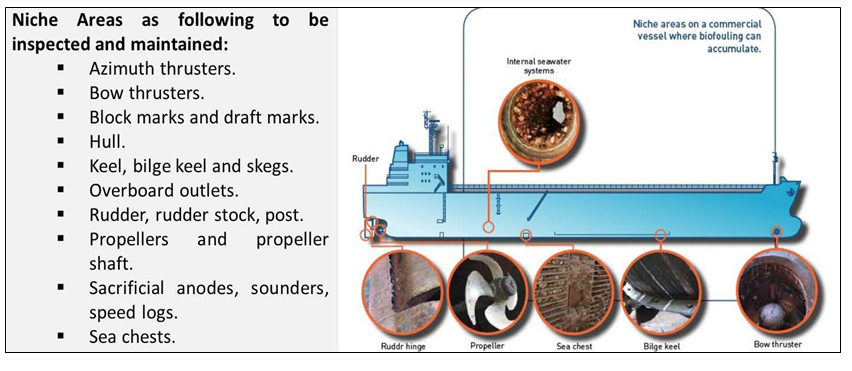
Niche Areas:The majority of biofouling on vessels is usually found in the niche areas. While the flat surfaces of the vessel might seem clean, the niche areas are protected from water movement, meaning biofouling accumulates easily in these areas. To avoid on-arrival delays, the vessel must have records of hull inspection & cleaning of the hull and especially niche areas as shown below:
4.BIO-FOULING RISK LEVELS:
This section applies as general guidance for all vessels irrespective of port calls. The Biofouling Risk categorization is generally classified as: Low Risk, Medium Risk, and High Risk, which depend on the antifouling system (AFS) age, condition of the AFS coating, and whether AFC has been applied to niche areas.
Low or Medium Risk:A vessel that has an AFC on the hull and all relevant submerged areas is assigned a lower risk compared to a vessel that has only partial AFC, either on its hull only, hull and some niche areas only, niches only, an expired AFC, or no AFC at all.
- A vessel that has an AFC within the recommended service life is assigned a lower risk compared to a vessel without or with an outdated AFC.
- Vessels that have correct documentation to demonstrate they have an AFC are allocated a lower risk compared to vessels that do not have documentation.
High risk indicators can include:
- An ageing or expired antifouling system.
- Frequent periods of being stationary at one or more places (e.g., the vessel might have been idle while bunkering or waiting for cargo) OR a high number of port calls.
- No proper Biofouling records and no underwater inspection or cleaning since the last docking.
| Note: If a vessel is assessed as medium or high risk of carrying biofouling, MPI-NZ will contact the agent or Master for records to prove how Bio Fouling management is done. Similar actions or response may be expected from other port state as well. |
5. BIO FOULING MANAGEMENT PLAN RECORDKEEPING & TRAININGS
Biofouling Management Plan (BFMP) and Record BookCompany-specific Biofouling Record Book will be used for all record-keeping as required under the Biofouling Management Plan. Until such a record book is received, vessels may continue to record in the pages of the Biofouling Management Plan itself.
- Record Keeping Requirements:Hull cleaning, inspection, and treatment during docking or afloat, along with antifouling coating (AFC), are to be maintained in the BMP.
- Antifouling certificates, including information on the antifouling system coating (AFC) application date, type, service life of AFC, film thickness, and areas applied, including niche areas.
- Dates and location of dry-dockings/slippings, including the date the ship was re-floated, and any measures taken to remove biofouling or renew/repair the antifouling system.
- The date and location of in-water inspections, the results of the inspection, and any corrective action taken to deal with observed biofouling.
- The dates and details of inspections and maintenance of internal seawater cooling systems, and records on the MGPS system and its operation/maintenance/repairs.
- Details of when the ship has been operating outside its normal operating profile, including any details of when the ship was laid-up or inactive for extended periods of time.
- Training:The Master and Chief Engineer are responsible for periodically training the crew on the Biofouling Management Plan and record-keeping, in line with this alert content (and attachments), which should be recorded in HSSEQ-05 covering Biofouling.
| Note: Recordkeeping to be changed over to company specific Bio Fouling record book. |